

Conferencing and Telepresence Market To Reach $33.21 Billion By 2030 Driven By Expanding Industry Demand
Conferencing and Telepresence Market Size

The Business Research Company
The Business Research Company’s Conferencing and Telepresence Global Market Report 2026 – Market Size, Trends, And Forecast 2026-2035
LONDON, GREATER LONDON, UNITED KINGDOM, October 1, 2026 /EINPresswire.com/ -- The conferencing and telepresence sector has seen remarkable expansion recently, driven by the increasing need for seamless virtual communication in today’s globalized work environment. As businesses and organizations adapt to new ways of working, this market is set to experience continued growth, fueled by technological advances and shifting workplace dynamics. Let’s explore the current market size, growth drivers, regional insights, and emerging trends shaping this industry.
Conferencing and Telepresence Market Size and Growth Outlook
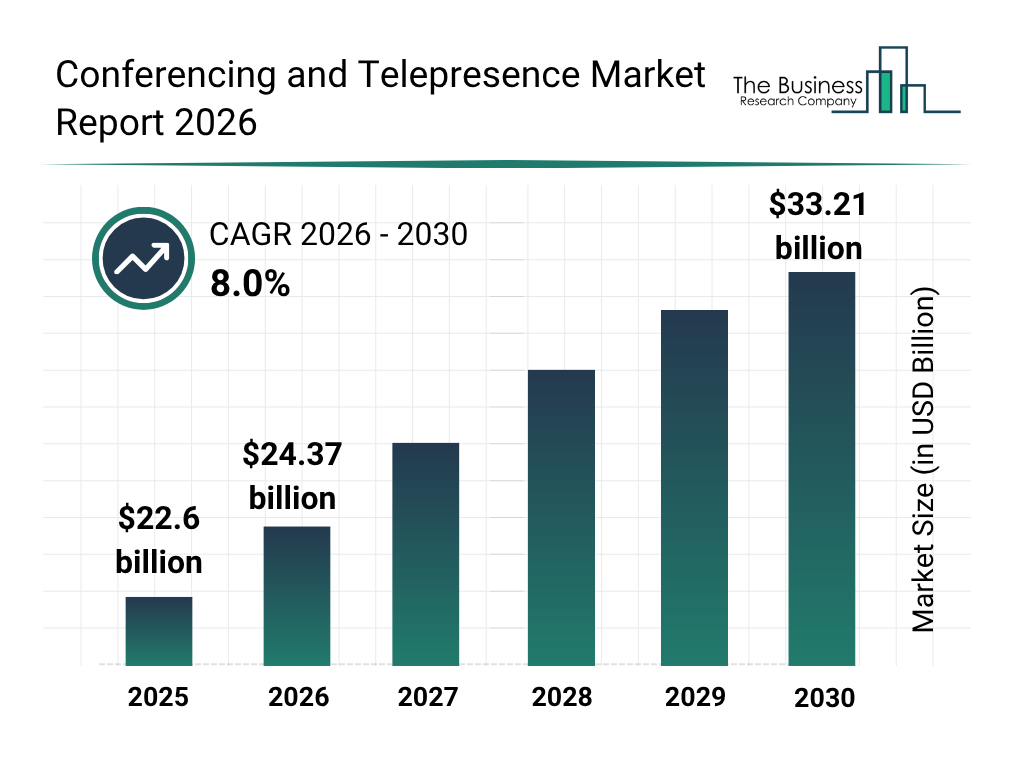
The conferencing and telepresence market has demonstrated strong growth, with its size expected to increase from $22.6 billion in 2025 to $24.37 billion in 2026, reflecting a compound annual growth rate (CAGR) of 7.8%. This expansion in recent years has largely been fueled by the widespread adoption of enterprise video conferencing, the globalization of distributed teams, rising broadband and internet availability, growing demand for remote communication tools within enterprises, and the proliferation of unified communication systems.
Download a free sample of the conferencing and telepresence market report:
https://thebusinessresearchcompany.com/sample_request?id=34260800&type=smp&name=Conferencing%20and%20Telepresence%20Market%20Report%202026&utm_source=EINPresswire&utm_medium=Paid&utm_campaign=Oct_PR
Looking ahead, the market is projected to continue its upward trajectory, reaching $33.21 billion by 2030 at a CAGR of 8.0%. Factors contributing to this sustained growth include the rise of hybrid work and remote-first work models, increased uptake of AI-powered meeting productivity tools, growing interest in immersive telepresence experiences, expansion of cloud-based communication platforms, and a stronger focus on enhancing workforce collaboration efficiency. Key trends expected to drive the market forward include AI-assisted meeting automation, broader deployment of cloud unified communication platforms, solutions that support hybrid workforce collaboration, adoption of spatial audio and immersive telepresence technologies, and advanced video analytics for optimizing virtual communication.
Understanding Conferencing and Telepresence Technology
Conferencing and telepresence solutions are digital communication platforms that enable live audio, video, and data collaboration among individuals or groups located in different places. They support virtual meetings, remote teamwork, and immersive communication experiences through features such as high-definition video, spatial audio, and interactive collaboration tools. By reducing the necessity for physical travel and facilitating smooth engagement among distributed teams, these technologies significantly boost business productivity and operational efficiency.
View the full conferencing and telepresence market report:
https://thebusinessresearchcompany.com/report/conferencing-and-telepresence-market-report?utm_source=EINPresswire&utm_medium=Paid&utm_campaign=Oct_PR
Remote Work as a Major Growth Catalyst
One of the primary factors driving the expansion of the conferencing and telepresence market is the ongoing rise of remote work. This working arrangement allows employees to fulfill their job duties outside traditional office settings by using advanced digital communication and collaboration technologies. The trend toward remote work is accelerating as organizations seek greater workforce flexibility, cost savings, and access to a global talent pool. Conferencing and telepresence systems are critical in enabling remote work by providing robust video conferencing, virtual meeting capabilities, and real-time communication that ensure seamless collaboration among geographically dispersed teams.
For example, data from the U.S. Bureau of Labor Statistics in March 2025 highlights this shift: during the first quarter of 2024, 35.5 million individuals in the United States worked from home or teleworked for pay. This figure represents an increase of 5.1 million compared to the previous year and accounts for 22.9% of all employed persons, up from 19.6% in the same period the year before. These statistics clearly demonstrate how the growth of remote work is propelling demand for conferencing and telepresence technologies.
Leading Regional Markets in Conferencing and Telepresence
In 2025, North America held the largest share of the conferencing and telepresence market. However, the Asia-Pacific region is anticipated to experience the fastest growth during the forecast period. The market report encompasses key geographical areas including Asia-Pacific, South East Asia, Western Europe, Eastern Europe, North America, South America, the Middle East, and Africa, providing a comprehensive perspective on global market dynamics.
Our latest 2026 market reports provide expanded strategic and visual intelligence with market attractiveness scoring and analysis, total addressable market (TAM) analysis, company scoring matrix graphics and tables, Excel-based forecasting dashboards, market hotspots infographics, key technologies and future trend analysis, together with updated graphics and tables.
Speak With Our Expert:
Saumya Sahay
Americas +1 310-496-7795
Asia +44 7882 955267 & +91 8897263534
Europe +44 7882 955267
Email: marketing@tbrc.info
The Business Research Company - www.thebusinessresearchcompany.com
Follow Us On:
• LinkedIn: https://in.linkedin.com/company/the-business-research-company
Oliver Guirdham
The Business Research Company
7882 955267
info@tbrc.info
Visit us on social media:
LinkedIn
Facebook
X
Legal Disclaimer:
EIN Presswire provides this news content "as is" without warranty of any kind. We do not accept any responsibility or liability for the accuracy, content, images, videos, licenses, completeness, legality, or reliability of the information contained in this article. If you have any complaints or copyright issues related to this article, kindly contact the author above.
